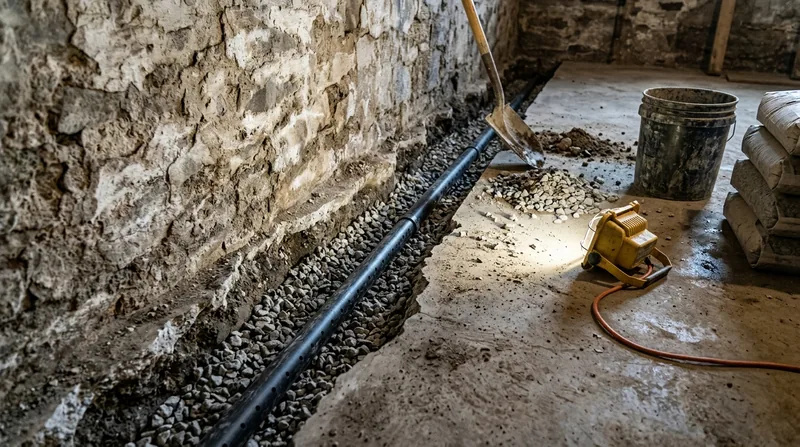


Interior Drain Tile System in Binghamton: Stop Water at the Footing, Not at the Wall
Binghamton sits in a deep valley where the Chenango River meets the Susquehanna, and that geography drives everything we see below grade. On the West Side and along Riverside Drive, 1870s to 1910s Victorian and Italianate homes sit on stone and brick foundations that have absorbed a century and a half of spring melt. In the First Ward, 1880s to 1930s frame two-family homes and cottages on full basements fight hydrostatic pressure every time the water table rises after a storm. If you are searching for an Interior Drain Tile System in Binghamton, you already know the pattern: water seeps at the cove joint, efflorescence blooms on the block, and the musty basement smell never quite goes away. We install interior perimeter drain tile beneath the slab edge, capture water at the footing, and channel it to a sump basin that pumps it out. It is a proven year-round answer for Southern Tier basements near the rivers, and we install it in any season, including deep winter. Start with a free basement inspection so we can tell you honestly whether drain tile is the right fix or whether simple crack sealing will do.
Why Binghamton Basements Need Interior Drain Tile, Not Just Another Coat of Sealer
Broome County's building stock and its climate create a specific failure mode. Glacial till on the South Side hills and in Vestal sheds runoff downhill toward foundations, while the river flats flooded in June 2006 and again during Tropical Storm Lee in 2011. Add heavy snow, a big spring melt, hard freeze-thaw cycles, and summer storms, and you get water arriving at the footing from below and from the side. That is hydrostatic pressure, and no amount of interior sealer stops it.
- Water at the cove joint where the wall meets the floor is the classic sign that the footing drain is overwhelmed.
- Efflorescence on block or brick walls tells you water is moving through the masonry and depositing salts.
- A wet basement after every rain in Johnson City and Endicott factory-worker houses usually means the original weeping tile is clogged or crushed.
- Sump pump failure during a spring melt turns a manageable seep into standing water fast.
- Bowing walls on older stone foundations signal pressure that has been building for years, not months.
When the water is coming up through the footing, an interior perimeter drain is the better answer than exterior excavation, and it costs less because we are not digging up your yard, sidewalks, or landscaping.
Key info: On a 1920s two-family in the First Ward, we found the original clay weeping tile packed solid with silt from the 2011 flood. The interior drain tile we installed captured water at the footing and sent it to a new sump basin, and the basement stayed dry through the next spring melt.
For the official word on what work requires a permit in the City of Binghamton, check the City of Binghamton building department before any drainage or structural work begins.
How We Install Interior Drain Tile in Binghamton Homes
We start by walking the basement and the exterior grade, because the fix has to match the source. On a 1950s ranch on the South Side hills, runoff from the slope may be the whole story, and a French drain uphill of the foundation changes the picture. On a poured-concrete basement in Vestal, the water is usually at the cove joint and the drain tile is the direct answer. We measure, we check the sump location, and we tell you plainly what we found.
- We break and remove a 12-inch strip of slab along the perimeter wall and dig down to the footing.
- We lay perforated drain tile in a gravel bed at the footing, pitched to the sump basin.
- We set the sump basin, connect the tile, and install a check valve on the discharge line.
- We cover the tile with washed gravel and dimple board, then pour new concrete over the trench.
- We tie the system to a sump pump and test it with water before we leave.
Every job ends with a wet test, so you see the water leaving the basement before we pack up.
Key info: A 1960s split-level in Vestal had water crossing the floor every March. We installed 70 linear feet of interior drain tile, a new sump basin, and a battery backup sump pump for the storms that knock out power. The next spring melt ran to the basin, not across the floor.
Interior Drain Tile System Approaches We Use in Binghamton
Not every basement needs the same layout. Stone foundations in Riverside Drive Victorians need a wider trench and more gravel than a poured wall in a 1990s Chenango home. We choose the approach after we see the footing, the wall material, and where the water is actually entering.
| Approach | Description | Best for |
|---|---|---|
| Standard interior perimeter drain | Perforated tile in gravel at the footing, pitched to a sump basin. | Poured and block basements with cove-joint seepage. |
| Stone foundation drain with dimple board | Wider trench, more gravel, dimple board against the stone to keep silt out. | 1870s to 1910s Victorian and Italianate stone foundations. |
| Drain tile plus wall vapor barrier | Interior drain tied to a sealed wall liner that sheds seepage to the perimeter. | Block walls with efflorescence and musty basement smell. |
| Drain tile plus sump pump replacement | New tile and basin paired with a properly sized pump and check valve. | Older systems where the pump has failed or is undersized. |
We match the approach to the house, not to a sales sheet, and we explain the tradeoffs before we cut any concrete.
Interior Drain Tile System Cost in Binghamton: What to Expect
Most interior drain tile work in Binghamton starts around $50 per linear foot, and that figure includes the trench, the perforated tile, the gravel, the sump basin, and the concrete patch. A typical 100-linear-foot basement perimeter lands in the $5,000 to $7,500 range, but the number moves with the house. Stone foundations take more labor than poured walls, and a basement with limited access or a finished ceiling adds time.
- Linear footage is the biggest driver, since we price the perimeter we actually trench.
- Foundation material matters: stone and brick take longer to cut and backfill than poured concrete.
- Sump pump and discharge add cost if you need a new pump, check valve, or a longer discharge line.
- Access through a finished basement or a narrow stair changes the labor, not the materials.
Get two or three written estimates and compare what is included, not just the bottom line. Our full pricing overview lays out the line items so you can compare apples to apples.
Interior Drain Tile System Near Me: How to Vet a Binghamton Waterproofing Contractor
You want a contractor who works below grade every week, not a general handyman who watched a video. Ask for proof of insurance, a written scope, and references from Binghamton or Johnson City homeowners with the same foundation type you have. Check whether the company carries Basement Health Association membership, which requires adherence to industry standards.
- Licensed and insured status should be documented, and a certificate of insurance should be available on request.
- Multiple estimates from two or three local companies keep the pricing honest and the scopes comparable.
- References from nearby homes with stone, block, or poured foundations tell you more than a brochure.
- Permits for structural work, egress cutting, or drainage changes vary by jurisdiction, so confirm with the local building department.
- Written warranty terms should be clear and transferable, and you should read them before signing.
If a contractor cannot explain why your basement is wet, keep looking. Call us at (607) 862-8699 to schedule a free inspection and get a straight answer.
Interior Drain Tile System in Binghamton: Pricing Guide
| Service | Price | Details |
|---|---|---|
| Interior perimeter drain tile | Starting at $50/linear ft | Includes trench, perforated tile, gravel, sump basin, and concrete patch along the basement perimeter. |
| Drain tile with vapor barrier | Starting at $65/linear ft | Adds a sealed wall liner and dimple board for block walls with efflorescence and seepage. |
| Stone foundation drain | Starting at $70/linear ft | Wider trench and more gravel for 1870s to 1910s stone foundations with irregular footings. |
| Sump pump and discharge package | Starting at $850 | New pump, check valve, and discharge line sized to the basin and the local water table. |
| Complex or large-scale job | On estimate | Finished basements, limited access, or structural repairs need an on-site look before a number is given. |
| Estimate | Free | Response within 24h at (607) 862-8699, no obligation to book. |
Indicative pricing, the exact cost depends on square footage, finish, and site access. Free personalized estimate within 24h at (607) 862-8699.


