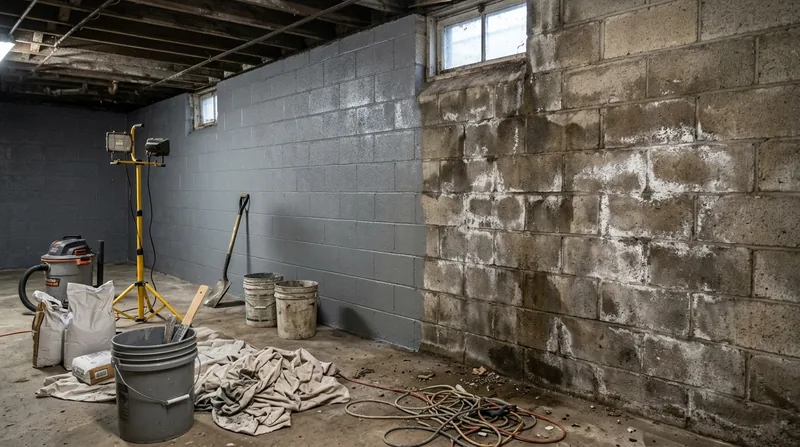


Binghamton sits where the Chenango River meets the Susquehanna, and that deep Allegheny Plateau valley decides how water moves under your house. On the West Side and along Riverside Drive, 1870s to 1910s Victorian and Italianate homes sit on stone and brick foundations that have been wicking moisture for over a century. In the First Ward, frame two-family homes and cottages on full basements take runoff from steep glacial till hillsides. Out in Vestal and Kirkwood, poured-concrete basements from the 1980s through the 2020s show damp walls after every big spring melt. Basement Wall Sealing in Binghamton is the right first move when your walls are damp, chalky, or weeping through the pores, not when groundwater is standing against the footing. We prep the surface, remove efflorescence, and apply the sealer that matches your wall material. Call (607) 862-8699 for a free basement inspection before you spend a dollar on sealer.
Why Basement Wall Sealing Matters in Binghamton's River Valley
Broome County's freeze-thaw cycles are hard on masonry. Water enters a hairline pore in fall, freezes, expands, and opens the pore wider by March. Add the heavy snowpack and the big spring melt, and damp basement walls are the norm, not the exception. Sealing stops that surface migration and the efflorescence it leaves behind, but it does not stop hydrostatic pressure pushing water through a footing drain that has failed. Knowing which problem you have is the whole job.
- Damp, chalky white staining on brick or block usually means vapor migration, and a penetrating sealer is the right call.
- Water seeping through a visible crack needs epoxy or polyurethane injection, not paint-on sealer.
- Water pooling at the wall base after rain points to a failed drain tile or a high water table, which sealing will not fix.
- Musty basement smell with no visible water often means damp masonry that a breathable membrane sealer can address.
We tell Binghamton homeowners plainly which of these four situations they are in before any product goes on the wall.
Key info: A 1905 brick foundation on Riverside Drive and a 1998 poured wall in Vestal need different sealers. Brick needs a breathable silane or silicate product so trapped moisture can escape. Poured concrete takes a membrane or crystalline sealer. Using the wrong one traps water inside the wall and makes spalling worse.
For official guidance on basement moisture and foundation maintenance, the City of Binghamton and the New York Department of State Division of Building Standards and Codes publish resources worth reading before any structural work begins.
How We Seal Basement Walls in Binghamton, Step by Step
We start with a free inspection, not a sales pitch. We walk the basement, check the wall base for efflorescence and staining, look at the footing drain and sump basin, and test whether the dampness is surface vapor or active seepage. Only then do we recommend a sealer, and sometimes the honest answer is that sealing is not the fix.
- We inspect the wall, footing, and drainage and identify the moisture source before quoting.
- We remove efflorescence, loose parging, and old failing paint so the sealer bonds to sound masonry.
- We fill active cracks with epoxy or polyurethane injection and install injection ports where needed.
- We apply the penetrating or membrane sealer matched to your wall material and cure time.
- We check grading and downspout extensions so roof water moves away from the foundation.
- We leave you a written summary of what we sealed and what to watch for next spring.
If the inspection shows hydrostatic pressure or a dead footing drain, we steer you to an interior perimeter drain instead of selling you sealer that cannot hold.
Key info: A Johnson City homeowner on a 1920s factory-worker house had white efflorescence on three block walls and no standing water. We removed the bloom, applied a breathable crystalline sealer, and extended two downspouts. That was the whole fix. A house two streets over with water at the wall base needed drain tile, and we told them so.
Sealing Approaches We Use on Binghamton Foundations
| Approach | Description | Best for |
|---|---|---|
| Penetrating silicate sealer | Sinks into brick and block pores and reacts with free lime to block vapor. | Damp Victorian and Italianate brick foundations on the West Side. |
| Crystalline waterproof coating | Grows crystals into concrete capillaries to seal hairline porosity. | Poured concrete basements in Vestal, Endwell, and Kirkwood. |
| Cementitious membrane | Troweled or sprayed coating that bridges small surface defects. | Block walls with rough parging in the First Ward and North Side. |
| Epoxy or polyurethane injection | Ports inject resin into active cracks to close them from the inside out. | Visible seeping cracks in any Binghamton foundation wall. |
| Elastomeric membrane sealer | Flexible film that moves with minor wall movement and sheds surface water. | Block walls with recurring damp patches and minor settling. |
Every approach above is a surface or crack solution. None of them replaces a footing drain, and we will say so when that is the real problem.
Basement Wall Sealing Cost in Binghamton: What to Expect
Most Binghamton basement wall sealing jobs start around $1,500 for a single wall or a small basement with straightforward access. That figure covers surface prep, efflorescence removal, and a quality sealer. From there, the number moves with wall length, wall material, how much old parging or paint has to come off, and whether we find active cracks that need injection first. A full basement with three or four damp walls on a 1920s block foundation runs higher than a single poured wall in a 1990s Vestal ranch.
Access matters too. A basement packed with shelving and a finished ceiling slows prep. Cracks that need epoxy injection add a line item. If the inspection shows hydrostatic pressure, the honest quote is for drain tile, not sealer, and we will tell you that before you commit. Get two or three written estimates and compare what is actually included, not just the bottom line. Our full pricing overview breaks down how each scope is built.
What to Look For When Hiring a Waterproofing Contractor Near Binghamton
Basement work attracts plenty of outfits that sell sealer as a cure-all. Here is how to sort the real specialists from the rest. Ask for proof of insurance and a current certificate, and confirm they carry general liability and workers' compensation. Ask whether they are a member of a trade association such as the Basement Health Association, which we are. Then ask what they will do if the sealer does not solve the problem.
- Request at least two or three local references from Binghamton, Johnson City, or Endicott and actually call them.
- Get a written scope that names the sealer, the prep steps, and what is excluded.
- Ask whether permits are needed for any structural or drainage changes, and confirm with the local building department, since rules vary by jurisdiction.
- Be wary of anyone who quotes a lifetime warranty or promises the sealer will stop hydrostatic pressure.
If a contractor cannot explain the difference between vapor migration and hydrostatic pressure, keep looking. You can reach us through our contact page to schedule a free inspection and get a straight answer about which problem you actually have.
Basement Wall Sealing in Binghamton: Pricing Guide
| Service | Price | Details |
|---|---|---|
| Single wall sealing | Starting at $1,500 | Surface prep, efflorescence removal, and one penetrating or membrane sealer on a single wall. |
| Full basement sealing | Starting at $2,800 | All accessible walls prepped and sealed, with downspout and grading check included. |
| Crack injection add-on | Starting at $450 per crack | Epoxy or polyurethane injection with ports when active cracks are found during prep. |
| Complex or large-scale job | On estimate | Finished basements, heavy parging removal, or multiple wall types need an on-site look first. |
| Travel | Included | in Binghamton and surrounding areas, no separate call-out or mileage fee |
| Estimate | Free | Response within 24h at (607) 862-8699, no obligation to book |
Indicative pricing, the exact cost depends on square footage, finish, and site access. Free personalized estimate within 24h at (607) 862-8699.


